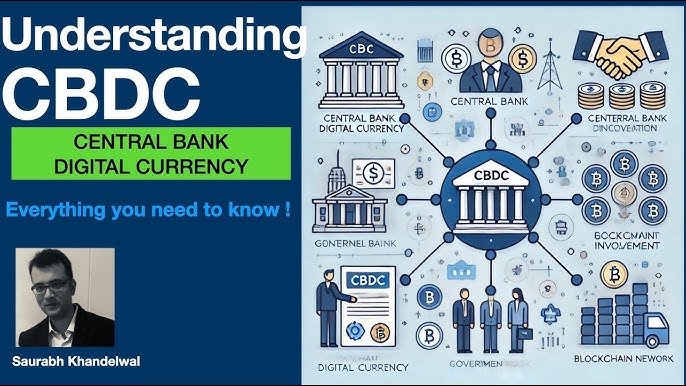
The world of finance is changing faster than ever. From online banking to cryptocurrencies like Bitcoin, digital innovation is reshaping how we use and think about money. But now, governments and central banks are stepping into the digital currency space with something new and powerful: Central Bank Digital Currencies (CBDCs).
In this article, we’ll provide a complete guide on Central Bank Digital Currencies (CBDCs) Explained, covering what they are, how they work, their benefits, risks, and what they could mean for the future of global finance.
If you’ve heard the term CBDC but don’t fully understand it, don’t worry. By the end of this guide, everything will be clear.
What Are Central Bank Digital Currencies (CBDCs)?
Let’s start with the basics.
Central Bank Digital Currencies (CBDCs) are digital versions of a country’s official currency, issued and regulated by its central bank.
Unlike cryptocurrencies such as Bitcoin or Ethereum, CBDCs are centralized. This means they are fully controlled by a government authority.
For example:
- The digital version of the US dollar would be issued by the Federal Reserve
- China’s digital yuan is managed by the People’s Bank of China
- The European Union’s digital euro would come from the European Central Bank
Simply put, CBDCs are government-backed digital cash.
Central Bank Digital Currencies (CBDCs) Explained in Simple Terms
To better understand Central Bank Digital Currencies (CBDCs) Explained, imagine this:
Right now, your money exists in three main forms:
- Physical cash (notes and coins)
- Bank deposits (digital but controlled by commercial banks)
- Cryptocurrencies (decentralized digital assets)
CBDCs would be a fourth form — digital money directly issued by the central bank, available for individuals and businesses to use.
This means instead of holding money only in a commercial bank account, you could potentially hold digital money directly backed by your country’s central bank.
That’s a major shift in financial structure.
Why Are Governments Introducing CBDCs?
There are several reasons why countries are exploring Central Bank Digital Currencies.
1. Decline of Physical Cash
In many countries, people use less cash and more digital payments. Mobile wallets, QR payments, and online banking are becoming standard.
CBDCs allow central banks to adapt to a cashless society.
2. Competition With Cryptocurrencies
The rise of cryptocurrencies like Bitcoin has shown that people want digital money. However, crypto markets can be volatile and unregulated.
Governments want to offer a stable, regulated digital alternative.
3. Faster and Cheaper Payments
CBDCs could:
- Reduce transaction costs
- Enable instant cross-border payments
- Improve financial efficiency
International money transfers today can take days and include high fees. CBDCs could change that.
4. Financial Inclusion
Millions of people worldwide do not have access to traditional banking. CBDCs could allow people to hold digital money using only a smartphone — no bank account required.
Types of Central Bank Digital Currencies
When discussing Central Bank Digital Currencies (CBDCs) Explained, it’s important to understand that there are two main types:
1. Retail CBDC
Designed for everyday consumers and businesses.
- Used for daily transactions
- Similar to digital cash
- Accessible to the public
2. Wholesale CBDC
Used by financial institutions.
- Designed for interbank settlements
- Large-scale financial transactions
- Improves banking system efficiency
Most public discussions focus on retail CBDCs because they directly impact everyday users.
How Do CBDCs Work?
CBDCs use secure digital ledger technology. Some may use blockchain, while others use centralized databases.
Here’s how a basic system might work:
- The central bank issues digital currency.
- Citizens download a government-approved digital wallet.
- Money is stored securely in the wallet.
- Transactions are processed instantly.
Unlike decentralized crypto systems, CBDCs remain under government control.
Countries Leading in CBDC Development
Several countries are actively testing or launching CBDCs.
🇨🇳 China – Digital Yuan
China is one of the most advanced nations in CBDC development. The People’s Bank of China has already launched pilot programs in multiple cities.
Millions of transactions have been processed using the digital yuan.
🇺🇸 United States – Digital Dollar Research
The Federal Reserve is studying the possibility of a digital dollar but has not officially launched one yet.
🇪🇺 European Union – Digital Euro
The European Central Bank is exploring the digital euro to complement physical cash.
🇮🇳 India – Digital Rupee
The Reserve Bank of India has launched pilot projects for the digital rupee.
Benefits of Central Bank Digital Currencies
When fully understanding Central Bank Digital Currencies (CBDCs) Explained, we must analyze their advantages.
1. Stability
Unlike cryptocurrencies, CBDCs are backed by government reserves.
2. Reduced Fraud
Digital tracking systems can help reduce illegal transactions.
3. Lower Transaction Costs
CBDCs may eliminate intermediaries, reducing fees.
4. Faster Payments
Transactions could settle instantly, even across borders.
5. Stronger Monetary Policy
Central banks could respond more quickly to economic crises using programmable money features.
Risks and Concerns of CBDCs
No financial innovation is without risks.
1. Privacy Concerns
If the government controls digital currency, it could potentially monitor transactions.
Privacy advocates are worried about financial surveillance.
2. Cybersecurity Risks
Digital systems can be hacked. A CBDC platform must be extremely secure.
3. Impact on Commercial Banks
If people move their money from commercial banks to central bank wallets, banks could lose deposits, affecting lending systems.
4. Government Control
CBDCs could give governments more control over spending patterns, which raises concerns about financial freedom.
CBDCs vs Cryptocurrencies: What’s the Difference?
Many people confuse CBDCs with cryptocurrencies.
Here’s a simple comparison:
| Feature | CBDCs | Cryptocurrencies |
|---|---|---|
| Issuer | Central Bank | No central authority |
| Stability | Stable (government-backed) | Volatile |
| Regulation | Fully regulated | Often unregulated |
| Control | Centralized | Decentralized |
In short, CBDCs are digital government money, while cryptocurrencies are decentralized digital assets.
Will CBDCs Replace Cash?
Most central banks say CBDCs will not replace cash immediately, but rather complement it.
However, over time, physical cash usage may decline further.
In highly digital societies, CBDCs could eventually become the primary form of money.
The Future of Central Bank Digital Currencies
As we continue exploring Central Bank Digital Currencies (CBDCs) Explained, it’s clear that CBDCs represent the future of finance.
Experts predict:
- More countries will launch pilot programs.
- Cross-border CBDC systems may develop.
- Integration with digital identity systems.
- Smart contracts and programmable money features.
CBDCs could transform how salaries, taxes, and government benefits are distributed.
How CBDCs Could Impact Everyday Life
Imagine:
- Receiving government benefits instantly.
- Paying taxes automatically.
- Sending international money in seconds.
- Reduced transaction fees on purchases.
CBDCs could simplify financial systems for billions of people.
Are CBDCs Good or Bad?
The answer depends on implementation.
If designed with:
- Strong privacy protections
- Cybersecurity measures
- Transparent governance
CBDCs could be a powerful tool for economic growth.
But without proper safeguards, they could create privacy and control concerns.
Balance is key.
Final Thoughts: Central Bank Digital Currencies (CBDCs) Explained Clearly
To summarize:
Central Bank Digital Currencies (CBDCs) are digital versions of national currencies issued and controlled by central banks.
They aim to:
- Modernize payment systems
- Improve financial inclusion
- Compete with cryptocurrencies
- Strengthen monetary policy
Countries like China, India, the US, and the European Union are actively researching or implementing CBDCs.
The future of money is clearly digital — and CBDCs are likely to play a major role in shaping it.
As technology continues to evolve, understanding financial innovations like CBDCs becomes increasingly important.
Now that you’ve read this guide on Central Bank Digital Currencies (CBDCs) Explained, you have a strong foundation to follow this global financial transformation.