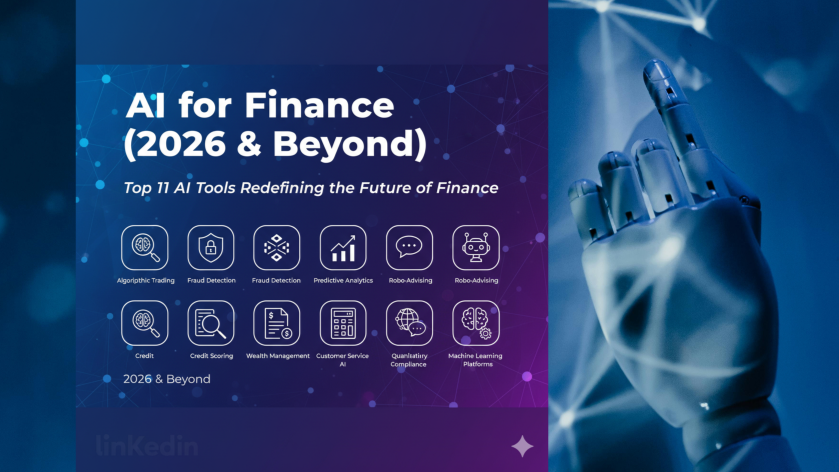
The financial industry has always been at the forefront of adopting new technologies, from automated teller machines to mobile banking apps. Today, nothing is reshaping the finance sector as dramatically as artificial intelligence (AI). In 2026, AI is no longer a futuristic concept—it has become an integral part of banking, investment, insurance, and financial decision-making. In this article, we will explore how artificial intelligence is changing finance in 2026, the technologies driving this transformation, and what it means for businesses and consumers alike.
1. Introduction: AI in Finance
Artificial intelligence refers to computer systems designed to perform tasks that usually require human intelligence, such as learning, reasoning, and problem-solving. In finance, AI is being applied to enhance efficiency, improve customer experiences, reduce risks, and generate higher returns. By analyzing massive datasets in real-time, AI can detect patterns and insights that humans may overlook.
In 2026, the finance industry is experiencing unprecedented AI integration. From predictive analytics to automated customer service, AI tools are changing the way financial institutions operate, enabling smarter and faster decision-making.
2. AI-Powered Customer Service
One of the most visible impacts of AI in finance is in customer interactions. Chatbots and virtual assistants are now commonplace in banks and investment firms. These AI-powered systems handle tasks ranging from answering basic account questions to providing personalized financial advice.
By 2026, AI chatbots have evolved to become more intuitive, understanding natural language, detecting sentiment, and offering context-aware responses. This development not only improves customer satisfaction but also reduces operational costs for financial institutions.
Example: Banks like JPMorgan and Citi are using AI-driven chatbots to manage millions of customer queries simultaneously, offering personalized solutions without human intervention.
3. Fraud Detection and Risk Management
Financial fraud is a persistent threat, and traditional methods often fail to catch sophisticated scams. AI is transforming fraud detection in 2026 by analyzing transactional data in real-time, identifying unusual patterns, and flagging potential fraud.
Machine learning algorithms are particularly effective because they continuously learn from new data. For instance, AI systems can detect subtle anomalies in transactions that may indicate identity theft, credit card fraud, or insider trading.
Additionally, AI enhances risk management in investment and lending. By analyzing historical data and market trends, AI models predict credit defaults, assess investment risks, and optimize portfolio management. This capability empowers financial institutions to make more informed decisions, minimizing losses and maximizing returns.
4. Personalized Financial Planning
AI is also changing personal finance. In 2026, AI-driven financial apps and platforms are helping individuals manage their money smarter. These tools analyze spending patterns, income, and financial goals to provide personalized recommendations, such as:
- Budget optimization
- Investment portfolio suggestions
- Retirement planning
- Loan management
Unlike generic financial advice, AI can tailor solutions for each user, accounting for unique financial behavior and risk tolerance. The result is a more proactive and personalized approach to managing money.
Example: Robo-advisors like Betterment and Wealthfront leverage AI to automate portfolio management while ensuring alignment with the client’s long-term financial goals.
5. Algorithmic Trading and Investment Insights
One of the most revolutionary areas where AI is transforming finance is in algorithmic trading. AI algorithms can process massive amounts of market data in milliseconds, identifying opportunities for profitable trades faster than human traders.
By 2026, AI-driven trading systems are not only faster but also smarter. They can predict market trends, optimize asset allocation, and adjust strategies dynamically based on real-time market conditions. This has led to more efficient markets and increased competitiveness in the financial sector.
Furthermore, AI provides investment insights for both institutional investors and retail traders. By analyzing social media sentiment, economic indicators, and company performance data, AI predicts market shifts with higher accuracy.
6. Regulatory Compliance and Reporting
Financial institutions face complex regulatory requirements, which can be time-consuming and expensive to manage. AI is changing this aspect of finance by automating compliance monitoring and reporting.
In 2026, AI systems can analyze regulations, monitor transactions for suspicious activity, and generate compliance reports automatically. This not only reduces human error but also ensures faster adaptation to regulatory changes.
Example: FinTech companies use AI-driven RegTech solutions to monitor transactions, detect money laundering, and comply with anti-fraud regulations efficiently.
7. AI in Lending and Credit Scoring
Traditional credit scoring models often rely on limited data, which can exclude many individuals from financial services. AI is changing lending practices by evaluating a wider range of factors, including alternative data like social behavior, digital activity, and payment patterns.
By 2026, AI-powered credit scoring models provide more accurate and inclusive assessments of creditworthiness, enabling financial institutions to offer loans to previously underserved populations. This democratizes access to finance while mitigating risk for lenders.
8. Insurance and Claims Processing
The insurance industry has also embraced AI to improve efficiency and reduce costs. AI algorithms can assess claims automatically, detect fraudulent claims, and predict risks.
In 2026, AI-driven predictive analytics allows insurers to offer personalized policies based on individual behavior and risk profiles. This shift benefits both the companies and the policyholders by providing fairer pricing and faster claim settlements.
Example: Companies like Lemonade use AI to automate claims processing, enabling users to submit claims via a mobile app and receive instant payouts.
9. Challenges of AI in Finance
Despite its benefits, implementing AI in finance comes with challenges:
- Data Privacy: Financial data is highly sensitive. Ensuring privacy while using AI is critical.
- Algorithmic Bias: AI systems may inadvertently inherit biases from historical data, affecting decision-making.
- Regulatory Oversight: Governments are still adapting to the rapid adoption of AI in finance.
- Job Displacement: Automation may reduce demand for traditional financial roles, requiring workforce reskilling.
Financial institutions must address these challenges proactively to harness AI responsibly and ethically.
10. The Future of AI in Finance
The trajectory of AI in finance suggests continued growth and innovation. By 2026, we expect AI to:
- Integrate with blockchain for secure, transparent transactions.
- Use advanced predictive analytics for global financial forecasting.
- Drive fully autonomous banking operations with minimal human intervention.
- Enhance cross-border finance and real-time currency exchange optimization.
As AI evolves, its impact on finance will continue to deepen, making financial services faster, more efficient, and more inclusive.
11. Conclusion
How artificial intelligence is changing finance in 2026 is evident across banking, investment, insurance, and personal finance. From fraud detection to personalized financial advice, AI is revolutionizing the way we handle money.
For businesses, AI offers efficiency, risk mitigation, and competitive advantages. For consumers, it provides smarter financial planning, faster services, and better access to credit. As we move further into 2026, embracing AI responsibly will be crucial for financial institutions aiming to thrive in this new era of technology-driven finance.
The future of finance is intelligent, adaptive, and automated—and AI is at the center of this transformation.